Sunday, 17 February 2013

Chestnut

Moth trapping in the winter is always hit and miss. There are fewer moths on the wing (though some moths only fly in this period) and winter, by definition, brings with it inclement weather. The ideal conditions for moth trapping are still, mild and cloudy nights. We have experienced little of these conditions in recent weeks, as our modest returns have shown.

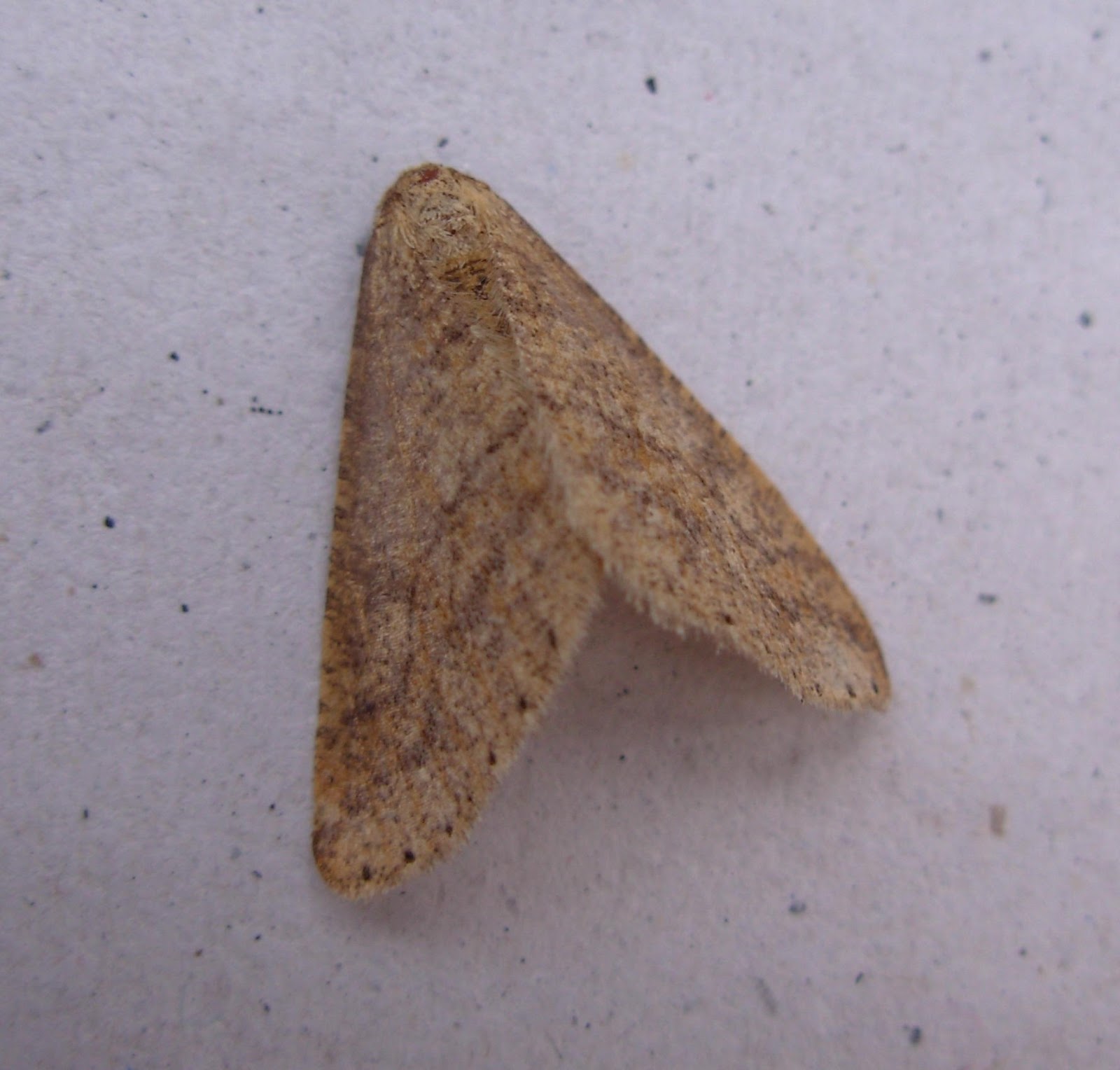
There are still moths out there though and I was very pleased last night to catch a common species that has eluded me, though not Graham. This is a Chestnut, a pretty little Noctuid moth that emerges between September and May. Individuals can vary, though as its name suggests they mostly have a striking chestnut colour, with some darker and dirtier than others.

Chestnut

Notice how this moth has rounded corners to the wings, the similar Dark Chestnut has squared off corners and this is a useful identification tip.

Friday, 15 February 2013

Weather or not to trap

No, that is not a spelling mistake!  There is not a  lot of sense in putting on the trap in very cold weather, although several people do so, and indeed the Rothamstead Institute traps are on every day!
But I normally do not bother unless the temperature is likely to stay above 5 or 6 degrees.
So the forecast for last night was for 6° and the trap went on.

Not a lot in there, but one new moth for us (a Dotted Border, pictured) and another moth to test our identification skills.

Dotted Border
I always thought the separation of the 3 "Brindled Beauties" was easy and in my post a few days ago I put up a photo which I called "Small". Earlier I had posted a photo of "Pale". You can look at these by clicking on the label list.

Mike said to me after the "Small" post that he would have named it "Pale" and this got me searching. However, the moth in the trap last night was very similar, and nothing like the "Pale" referred to above.

It just so happened that on Saturday there was the Shropshire Ento Day at Preston Montford (a superb day of great interest - thanks to all there) and so I took the moth with me to ask the experts - and there were several. And, in the end, it was decided that this is indeed a Pale Brindled Beauty, in spite of its at first sight very yellow appearance.  Have a look and see if you agree!


Pale Brindled Beauty


Weather or not to trap

No, it is a deliberate spelling mistake

Friday, 1 February 2013

Thank you for the gardens

Stretton Moths attended the public meeting of the Strettons Area Community Wildlife Group yesterday at Church Stretton School. It was great to see lots of residents of the Strettons come along to hear about wildlife surveys and how they can get involved. We have a vested intersted ourselves, as we have both found our way onto the committee. Graham is Chair, and I am Assistant Webmaster. We also wanted to get people interested in moth recording. Have a look at the website.

Our offer is simple. We will visit peoples gardens, help set up the moth trap in the evening, see what comes in and go through the catch in the morning. All we need is a garden and a plug socket (and maybe a cup of coffee or two!). People can invite their friends and neighbours round to look at the catch. If they want to start trapping themselves then we will help them, if they just want to see what is in their garden then that is great too. We had lots of interest, with ten people signed up so far, including four people who have their own moth traps and want to get started recording moths.

Moth trap running in Batch Valley

Why are we doing this? Well partly it is a nice thing to do and in different gardens we may find some new species. Partly we want to get people interested in moths and wildlife as they may join conservation organisations and consider wildlife in their lives. However, a large factor is that moths are under recorded in Shropshire and we want more people to record them so we can better understand their distribution and populations.

Coincidently, today saw the launch of Butterfly Conservation's report on the State of the Britain's Larger Moths 2013 click here. This is not happy reading, as it describes large declines in many of our moth species. What does this mean for the Strettons? Well last year we recorded two of the five species of moths that have suffered the biggest declines in Britain - I recorded several Hedge Rustics, which has declined by 97% in the last 40 years, and Graham recorded a Dusky Thorn, which has declined by 98% over the same period. If declines continue then how much longer will these species be with us?

Dusky Thorn has declined by 98%, but we found this one in the Strettons

If you live in the Strettons in Shropshire and want to get involved with moth recording then why not get in touch? Reply by posting a comment to this blog with your email address. Comments are moderated by us so we will not publish them and will delete them once we have noted your details.

Wednesday, 30 January 2013

After the cold rush ...

With the forecast for reasonably warm nights for Monday and Tuesday, it was a good idea to put the trap on. All the more so that it is the AGM of the Strettons Area Community Wildlife Group (SACWG) tomorrow night and it will be nice to take some speciments to show.

So, the idea proved to be a good one as there were 25 moths on Monday and nearly 50 last night, though over half were Spring Ushers.

As would be expected, since we have only been trapping here since August, each month should produce new moths and January has now done so, though nothing that could not be expected.

In December I caught an early Pale Brindled Beauty and in the trap were several more of them, but in addition, their smaller, darker 'cousin', a Small Brindled Beauty (also a bit early). Their larger 'uncle' the Brindled Beauty is still to come.

You can compare the Small and Pale versions by clicking on the "Labels" on the right.


Small Brindled Beauty
The first of the common spring micro-moths turned up in number this morning. This moth is called Tortricoides alternella, its name being much bigger than the moth is. It has no "English" name. A pleasant surprise was to find an Acleris hyemana and a Ypsolopha ustella also present. Both of these moths have featured before in the blog, but the latter without its photo..


Tortricoides alternella

 
Ypsolopha ustella
This moth can be very variable, but the small "spike" sticking up on the 'palps' (its "nose" ) is an aid to identification. This can clearly be seen if you enlarge the photo. 

Thursday, 3 January 2013

Anything you can do ...

I can do as well (sometimes!) So, because the forecast was for a balmy night,  I too put my trap on, and yes, Spring was Ushered in here too!


Spring Usher
It was in the trap with 2 Mottled Umbers and an agonopterix, which I have spent a long time trying to identify and arrived at the same answer at the end as I had assumed at the beginning.
Agonopterix heracliana, a moth which can be found all year round, but, like the Spring Usher, is a first for us here.


I just could not get a better picture of the agonopterix.


Agonopterix heracliana

Sign of spring

It has finally stopped raining in the Shropshire Hills, and with blue skies and sunshine, robins in song and slowly lengthening days it feels like spring may be on its way. How very apt then that on my first trapping session of the year last night that I caught a Spring Usher. This is a new moth for us in the Strettons and one which will be on the wing for the next couple of months.

Spring Usher
As with some of the other moths of the winter, this is easily identifiable as a male as the female is flightless. It is a species that likes oak, and I like to think that the large oak tree behind the house is part of the reason it is here.